- Home
- Case Studies
- Insert Molding Process For Small Batch Of Table Connectors Production
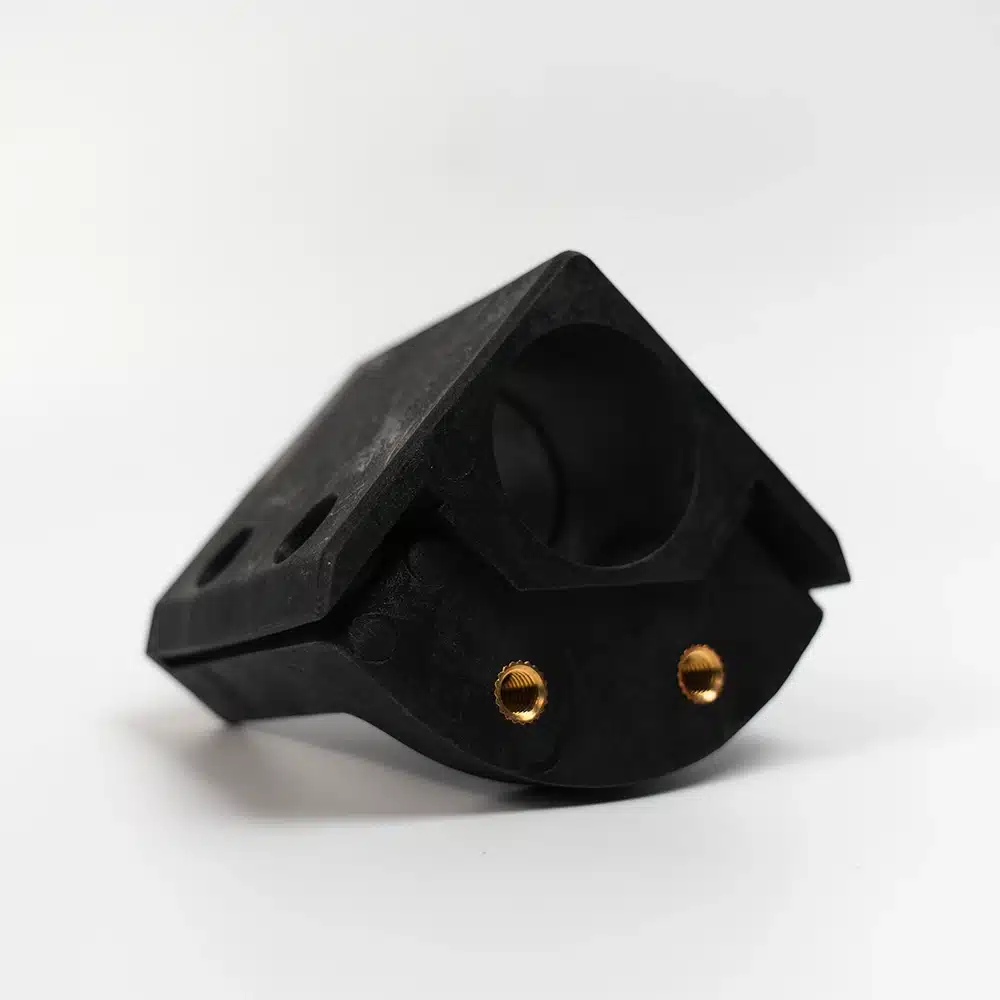
Insert Molding Process For Small Batch Of Table Connectors Production
| Manufacturing Process | Insert Molding Service |
| Parts Material | PA66+50%GF, Brass |
| Mold Type | Rapid Tooling |
| Application Industry | Tools & Equipment |
| Surface Treatment | None |
| Tolerance(Accuracy) | Parts: ±0.1mm(±0.004″) |
Notes:
We have pre-market confidentiality agreements with all of our customers. All the cases you see have been communicated with our clients. We have mosaiced some sensitive information. All the pictures are taken from TwoWing Mold’s internal shooting, thanks for your support and cooperation~
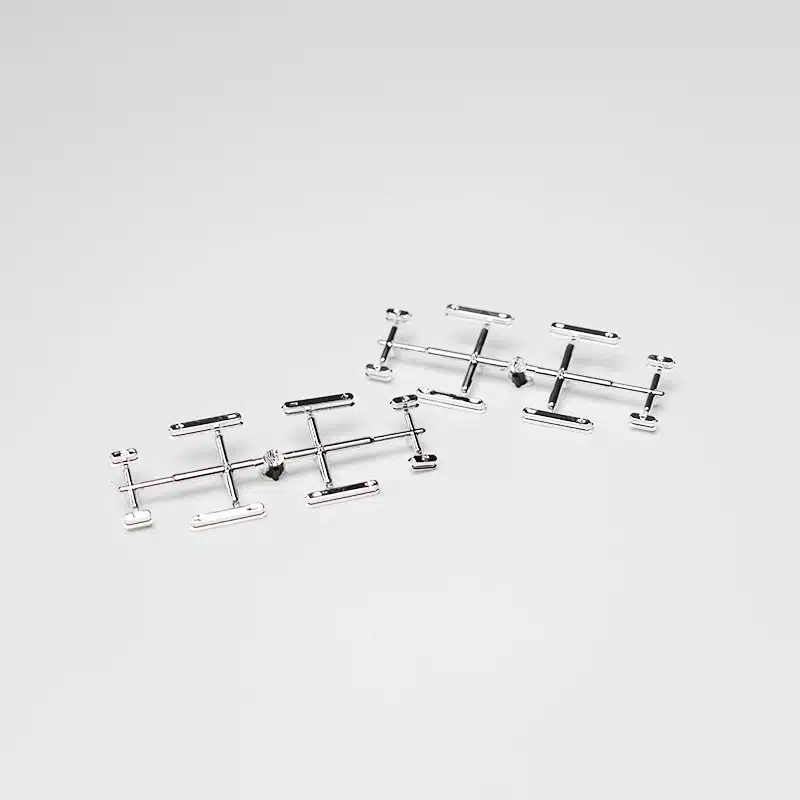
1. Dimensional Accuracy and Tolerances
The small button parts should adhere to precise dimensional specifications, with acceptable tolerances within ±0.02mm.
2. Surface Finish and Appearance
- Surface Roughness (Ra): The surface roughness should not exceed 0.8 microns, especially post-electroplating.
- Visual Inspection: 98% of the produced parts must be free of noticeable surface defects, with only 2% allowance for minor blemishes that do not affect the overall appearance or functionality.
- Electroplating Uniformity: The electroplated surface must be uniform, with a maximum thickness variation of ±5 microns across the entire batch.
3. Structural Integrity
- Material Strength: The buttons must have a minimum tensile strength of 45 MPa.
- Impact Resistance: The components should withstand an impact energy of at least 2.5 J without cracking or significant deformation.
4. Probable Injection Molding Defects and Specifications
- Sink Marks: Less than 1% of the total parts produced should exhibit sink marks deeper than 0.1mm.
- Flow Lines: Maximum allowable flow lines should not exceed 0.2mm in width and should be present in no more than 0.5% of the parts.
- Weld Lines: Must be limited to areas less critical to aesthetics and function, with a length not exceeding 5mm in no more than 0.8% of the parts.
- Burn Marks: Acceptable in less than 0.1% of the batch, with discoloration not extending more than 0.5mm from the edge.
- Flash: Maximum flash should not exceed 0.1mm in thickness, with a maximum length of 1mm along the parting line, present in no more than 0.5% of the parts.
- Short Shots: No more than 0.05% of parts should be incomplete, ensuring nearly all components are fully formed.
Q1. What are the common materials used in the injection molding of small parts and writing board components?
Common materials used in the injection molding of small parts and writing board components include ABS, polycarbonate (PC), polypropylene (PP), and nylon (PA). These materials are chosen based on their properties, such as durability, ease of molding, surface finish, and cost-effectiveness.
Q2. How does the injection molding process work for small components?
Injection molding involves melting plastic pellets and injecting the molten material into a mold cavity under high pressure. The material cools and solidifies to form the desired shape. This process is highly efficient for producing large quantities of identical parts with precise dimensions.
Q3. What factors determine the cost of injection molding for small parts?
The cost of injection molding is influenced by several factors, including the complexity of the part design, the type of material used, the number of cavities in the mold, and the production volume. Tooling costs for mold fabrication are also a significant factor, as more complex molds require more time and expertise to create.
Q4. How does TwoWing Company ensure the quality of small parts produced through injection molding?
TwoWing Company ensures quality through rigorous quality control measures, including dimensional inspections, surface finish evaluations, and material property testing. We use advanced technologies, such as computer-aided design (CAD) and computer-aided manufacturing (CAM), to design precise molds and ensure consistent production.
Q5. What are the typical lead times for producing small parts through injection molding?
Lead times can vary based on the complexity and volume of the order. For standard small parts, the typical lead time ranges from 4 to 6 weeks, including mold design and fabrication, production, and quality assurance. Custom or complex projects may require additional time.
Q6. Can TwoWing Company provide custom mold designs for unique part requirements?
Yes, TwoWing Company offers custom mold design services tailored to meet specific part requirements. Our experienced design team works closely with clients to create molds that accommodate unique shapes, sizes, and functional features. We use state-of-the-art CAD software to ensure precision and accuracy in mold design.
Q7. What are the typical applications of injection-molded small parts in writing boards and other products?
Injection-molded small parts are widely used in writing boards for components such as buttons, connectors, frames, and holders. These parts are also commonly found in electronic devices, automotive components, medical equipment, and consumer goods, where precision and durability are essential.
Q8. How does TwoWing Company handle large-volume orders for small parts?
TwoWing Company is equipped to handle large-volume orders efficiently. We use multi-cavity molds and advanced automation systems to maximize production rates and minimize cycle times. Our scalable production capabilities allow us to meet high-volume demands while maintaining consistent quality.